Neal Logiudice
Defending JacobNeal Logiudice is the ambitious prosecutor who rises from Andrew Barber’s protégé to his courtroom opponent in the prosecution of Jacob Barber. His career brings the novel’s central tension between legal procedure and narrative persuasion into focus: Neal is skilled at playing the system and shaping a case for jurors, yet his confidence in that machinery cannot prevent the prosecution from collapsing or the damage to his own standing.
Identity and Career
A dozen years after joining the prosecutor’s office, Neal has become First Assistant in the Middlesex District Attorney’s Office, the district attorney’s number two and chief trial attorney. He has taken the position Andrew once held. The career milestone carries a personal echo: as a young prosecutor, Neal had told Andrew that he was exactly what he wanted to become. Andrew recalls that exchange with the hindsight that he should have seen Neal’s rise coming.
Neal’s advancement is not presented as the product of an uncomplicated relationship with his former mentor. Andrew regards him as a former student whose courtroom habits reflect Andrew’s own instruction. When Neal persists with a line of questioning, Andrew recognizes the method as the one he taught: keep to the system, whatever the weakness of the case, and use the adversarial tactics associated with cross-examination. The inheritance is professional as well as personal; Andrew watches his former lesson return in the hands of the prosecutor now opposing him.
Prosecution and Courtroom Method
At Jacob’s court appearance, Neal presents the case in the language of danger and risk. He asks for bail of $500,000 cash or $5 million surety, arguing that the alleged crime’s severity, the likelihood of conviction, Jacob’s sophistication, and the family’s unusual circumstances make flight a particular concern. He characterizes the Barber household through the idea that criminal law is the family business, turning family history into part of the prosecution’s argument about Jacob.
Neal also objects to Jonathan Klein appearing for the defense, because Klein had previously represented another suspect in the same homicide. He argues that confidential information from the earlier representation could affect Jacob’s defense and suggests that the arrangement might lay the groundwork for an appeal claiming ineffective assistance. The objection extends the case beyond the question of Jacob’s guilt: Neal challenges whether the defense itself can properly be constituted, while Klein’s role becomes another contested feature of the proceedings.
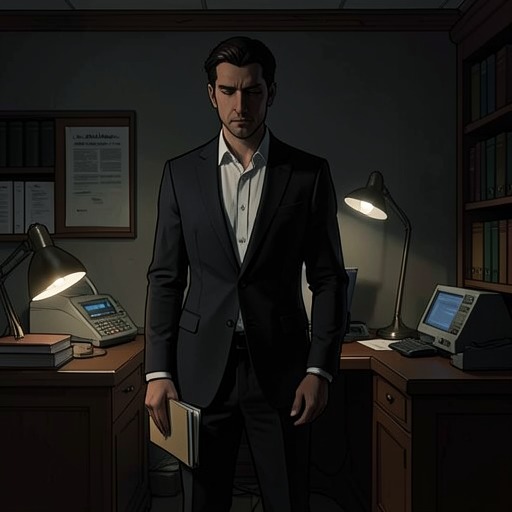
In court, Neal’s style is carefully staged. Before an appearance, he straightens his tie and adjusts his coat; as he begins his opening statement, he buttons the top two buttons of a new, fashionable suit under the gaze of two unmanned cameras. Andrew reads the gestures as part of Neal’s self-presentation, though he cannot know what Neal is thinking. The narrative sets that polished public image beside Andrew’s suspicion that Neal sees his own ambitions as aligned with the public good, and beside the fact that Jacob is the person those ambitions place at risk.
Neal’s opening statement begins with the circumstances of Ben Rifkin’s death: a fourteen-year-old found in Cold Spring Park on a spring morning, after being stabbed and left near the route between home and school. But Neal’s task is not simply to repeat the facts. The trial’s own account of advocacy explains that jurors need a story about what the case means, a theme they can carry into deliberations. Neal presents Ben as an ordinary boy who teased Jacob in the familiar setting of school, then faces the harder question of how a boy with no known history of violence could commit such a brutal act. The account identifies the weakness in the prosecution’s explanatory story: Neal can offer theories and probabilities, including a proposed genetic predisposition, but no settled motive that answers the jurors’ demand to understand why.
Conflict with Andrew and the Defense
The trial makes the former mentor and protégé adversaries in public. Neal questions Andrew about his pursuit of Leonard Patz, asking whether he continued following Patz and suggesting that Andrew had withheld evidence because jurors who heard it would not believe Jacob was responsible. He presses Andrew over cautious language in a prior assessment, treating phrases such as a colorable argument as hedging. These questions turn Andrew’s independent search for an alternative suspect into a possible attack on his integrity and judgment.
Neal also seeks to limit what the jury may hear. He files a motion in limine to exclude scientific evidence concerning an alleged genetic predisposition to violence. The motion illustrates the competing professional boundaries at issue: the defense wants to bring scientific interpretation into Jacob’s case, while the prosecution challenges whether that evidence should reach the jury. Elsewhere, Neal asks Andrew when he learned that Andrew’s father was a murderer, bringing Andrew’s family history into the proceedings. In the trial’s logic, lineage becomes both a subject of evidence and a weapon of courtroom questioning.
His conduct is not uniformly forceful. When Andrew’s colleague Lynn Canavan says she is uncomfortable, Andrew initially mistakes her seriousness for a joke, in part because she had once teased people in that way. The moment underscores that Neal’s case is unfolding amid strained professional relationships and uncertainty about whom Andrew can trust, though the evidence does not establish that Neal caused Lynn’s discomfort. Andrew’s account of Neal remains personal and partial: it combines professional observation with the perspective of a man facing the former pupil whose success once seemed to follow from Andrew’s own teaching.
Ambition, Pressure, and Decline
During the trial, Neal’s confidence appears to rise after testimony from professional witnesses. He moves restlessly around the courtroom, from witness stand to jury box and prosecution table, before settling at the lectern. Andrew suspects that Neal is on edge about the civilian witnesses—Jacob’s classmates—and determined not to let their testimony undermine the prosecution as earlier witnesses had. The contrast between Neal’s self-assured public posture and his restless movement suggests pressure, but the account marks that reading as Andrew’s inference rather than direct access to Neal’s thoughts.
The case’s outcome is not the only measure of Neal’s position. In April 2008, he finally subpoenas Andrew to appear before the grand jury, but Andrew judges the summons to have come too late. He says the delay is too late for the case and too late for Neal: the prosecutor’s reputation has already been damaged beyond repair, with his career damaged along with it. Andrew describes the office as a place where a prosecutor may survive for a time with a damaged reputation, only to be watched closely by colleagues and eventually forced out. In his account, institutional loyalty is conditional; a prosecutor can be indispensable one day and forgotten the next.
Narrative Significance
Neal embodies the power and limits of legal storytelling. He knows that jurors need a coherent account, frames Jacob through family history and alleged risk, and tries to prevent evidence about Patz or genetic predisposition from reshaping the case. Yet the prosecution’s central question—why a seemingly nonviolent boy would commit the crime—remains difficult to answer through theory alone. Neal can supply a courtroom narrative, but the novel places that narrative beside unresolved evidence, competing interpretations, and the consequences of turning suspicion into a public case.
His arc also gives Andrew’s past a living form. Neal once looked to Andrew as a model; now he occupies Andrew’s former office and questions him in court. The reversal is not presented as simple revenge, but it sharpens the cost of Andrew’s earlier lessons: the procedural tactics he taught can be used against him, and professional advancement does not guarantee sound judgment or lasting security. By the time Neal summons Andrew before the grand jury, the case has already altered the reputation that accompanied his rise.